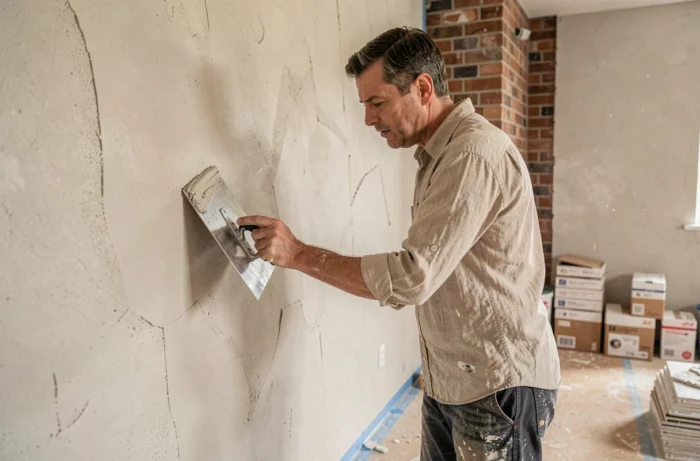
A renovation project that goes awry rarely stems from a poor choice of paint. It arises from a poorly timed technical sequence, a batch started too early, or a material specified without checking its compatibility with the existing structure. We will detail the real friction points, those that generate costly rework on home renovation projects.
Compatibility of substrates: the diagnosis that no one accurately assesses
Before discussing budget or schedule, the primary technical question concerns the nature of the existing substrates. A cement render applied to a stone wall traps moisture through capillarity and causes invisible issues for months. A self-leveling compound poured onto a non-absorbent slab will not hold, regardless of the bonding primer used.
We recommend conducting a targeted destructive survey on each type of wall before finalizing the work description. A simple core sample taken from a load-bearing wall provides information about the actual composition (rubble, solid brick, hollow block, timber frame) and avoids specifying an insulation system incompatible with the substrate.
This point differentiates a controlled renovation from a project that accumulates amendments. When you plan the work to be done with Maisons et Conseils, this diagnostic step conditions all subsequent decisions, from the choice of insulation to the potential replacement of lintels.
Scheduling of batches in renovation: insulation, ventilation, heating
The order of interventions in renovation is not a suggestion; it is a physical constraint. Insulating without addressing ventilation creates a sealed home that concentrates moisture. Installing a heat pump before insulating the walls amounts to oversizing a generator that will become unsuitable once the envelope is treated.

The technical sequence to follow in a comprehensive renovation project adheres to a thermal logic:
- First, address the envelope (insulation of walls, roof, replacement of windows) to stabilize the heat loss of the home.
- Then, adapt the ventilation to the new level of airtightness, sizing the flows according to the actual partitioned volumes.
- Install the heating system last, calibrated to the residual needs after insulation and ventilation.
Reversing the last two batches is common among homeowners eager to regain thermal comfort. The result: oversized equipment, consumption exceeding forecasts, and a degraded return on investment.
Particular case of windows installed before external insulation
Replacing windows before installing external thermal insulation (ITE) requires planning for a frame wide enough to accommodate the future thickness. If the joinery is installed in a tunnel without this anticipation, it will either need to be removed or accept a thermal bridge at the frame. The additional cost of rework far exceeds that of coordinating in advance with the carpenter and the facade contractor.
Energy Performance Certificate (DPE) and regulatory timeline: what landlords must anticipate
As of January 1, 2025, homes classified G on the DPE can no longer be newly rented out in mainland France. Homes classified F will follow on January 1, 2028. This timeline turns energy renovation into an obligation for all landlord owners.
A simple cosmetic refresh is no longer sufficient to put a property back on the rental market. The preliminary energy audit, more detailed than the DPE, identifies work scenarios that allow reaching at least class E, with associated cost estimates for each item (insulation, heating, ventilation).
My Renov’ Advisor and MaPrimeRénov’
For large-scale renovations, turning to My Renov’ Advisor is now a prerequisite for accessing Anah aid. This advisor assists with the initial diagnosis, defining the work scenario, and administrative follow-up until project completion. We observe that files prepared without this support accumulate requests for additional documents and delay the payment of bonuses by several months.
Integrating this approach from the project design phase, even before consulting artisans, significantly streamlines the administrative process and secures the financing plan.
Choice of materials and quotes: reading between the lines of the description
A renovation quote is judged by the precision of its technical description, not by its total amount. A quote that mentions “acrylic paint” without specifying the number of coats or the weight of the primer leaves the door open to a mediocre finish with no recourse possible.
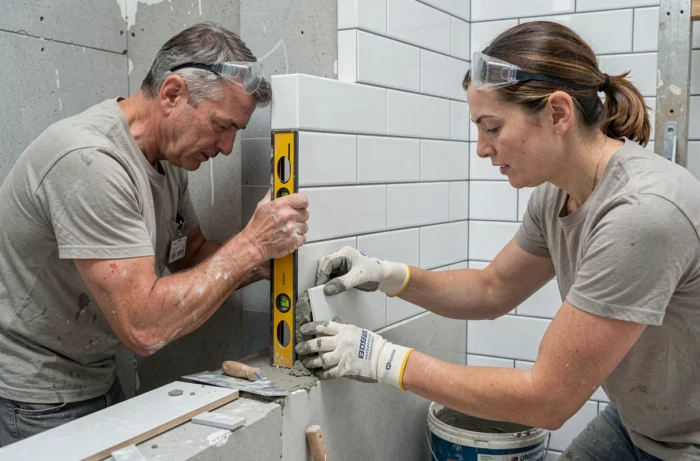
Points to verify on each batch before signing:
- The exact designation of materials (brand, reference, thickness for insulation, UPEC classification for tiles).
- The conditions of implementation (minimum application temperature, drying time between coats, type of mechanical or glued fastening).
- The excluded services, often relegated to the bottom of the page: removal of existing materials, disposal of debris, protection of adjacent works.
- The provisional schedule batch by batch, with interdependencies (the plasterer cannot intervene until the electrician has pulled his conduits).
Comparing three quotes solely based on the price per square meter is like comparing three recipes based only on the cost of ingredients. The quality of implementation, intervention timelines, and the strength of ten-year guarantees make the real difference between two artisans or building professionals.
Budget and contingency margin
Every renovation project in an old building reserves structural surprises. A floor that sags once the covering is removed, a lead pipe discovered in a partition, a cracked lintel hidden by a lining. Planning a margin of at least ten percent of the total budget remains the recommendation we uphold on every site, regardless of the apparent condition of the building.
The classic trap is to consume this margin on aesthetic choices (more expensive tiles, high-end faucets) before even finishing the structural work. Protecting this envelope for technical contingencies safeguards the financial coherence of the project until completion.
A successful renovation project hinges on the two months leading up to the first strike of the hammer: diagnosing the substrates, sequencing the batches, and carefully reading the quotes. The rest, as satisfying as it may be, is merely the consequence of this technical preparation.