Since 2024, the thermal renovation of old buildings in France follows a regulatory framework that overlaps several provisions. Three regimes coexist for existing buildings, each with its own triggering thresholds and technical requirements. In addition, there is an energy decency timeline that concerns landlords and an expanded energy audit during sales. Understanding which regime applies to which project and what leeway remains for old buildings conditions every decision regarding renovations.
Old buildings and the calculation method for the energy performance diagnosis (DPE): a persistent gap
The legal definition of an old building was clarified by a bill adopted by the Senate in March 2025. It designates a building constructed before 1948 using traditional techniques and materials (stone, earth, old brick, half-timbering). This distinction is not cosmetic: it conditions the way renovation work must be conceived.
The energy performance diagnosis (DPE) remains a point of friction for these constructions. The calculation method incorporates a modulation related to the heavy inertia of certain old walls. In practice, a thick stone wall does not behave like a concrete block partition, and the slow release of accumulated heat alters the actual thermal balance of the dwelling.
The proposal for a specific DPE for old buildings remains a parliamentary recommendation, not a rule in force. Professionals working on these projects must contend with a diagnostic tool designed for more recent constructions, which can distort the label obtained. For everything about Veriscope and the standards applicable to existing buildings, the intersection between the DPE method and the constraints of old buildings deserves particular attention.

Existing RT by element or global: which regime applies to your project
The regulatory framework distinguishes two main regimes based on the surface area and nature of the work undertaken.
Element-by-element thermal regulation
This regime concerns the majority of renovation projects. As soon as a project owner replaces or installs an insulation element, a heating system, hot water production, cooling, or ventilation equipment, they must comply with minimum performance standards set by the decree of May 3, 2007, amended on January 1, 2018. The principle is simple: each replaced component must meet a defined performance threshold.
This regime applies to buildings of less than 1,000 m², and under certain conditions to buildings over 1,000 m². It does not require a global thermal calculation of the building.
Global thermal regulation
For buildings over 1,000 m² undergoing major renovations, the global regime imposes a different approach. The calculation focuses on the overall energy performance of the building after work, not just on each component taken in isolation. The requirements pertain to primary energy consumption and thermal comfort.
A third provision, known as embedded works, requires the integration of a thermal insulation component during significant renovation work (facade renovation, roof refurbishment, transformation of premises). This mechanism aims to seize the opportunity to improve the thermal envelope when a project is already underway.
Energy decency timeline and audit at sale: the piling obligations
Beyond the technical rules related to the work, two provisions constrain owners regardless of any renovation decision.
- In mainland France, homes rated G on the DPE are no longer considered decent for a new lease or its renewal since 2025. Classes F and E will follow according to the regulatory timeline. A landlord may find themselves unable to rent without having undertaken voluntary work.
- The energy audit at sale, already mandatory for homes rated F and G, has been extended to homes rated E in 2025. This audit includes an on-site visit and work scenarios that must take into account the technical, architectural, or heritage constraints of the building.
- The proposed works contained in the audit must present a cost proportionate to the value of the property, which introduces an explicit economic limit into the regulatory framework.
These two mechanisms create increasing pressure on owners of old buildings, often rated in the low labels of the DPE due to the calculation method mentioned above.
Heritage constraints and thermal renovation: the arbitration that the regulation does not resolve
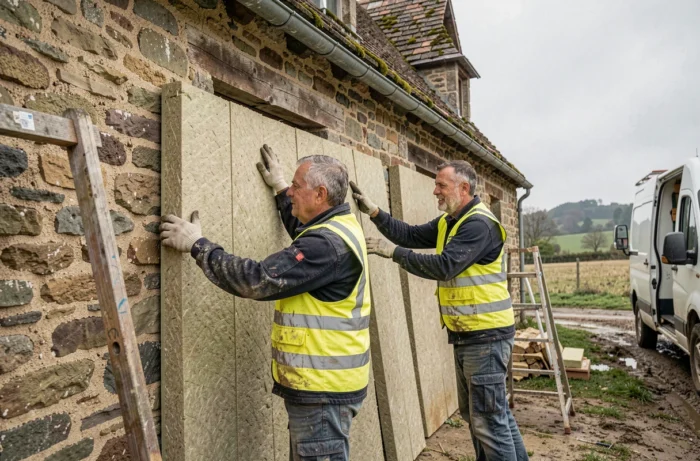
Renovation work visible from public space may fall under a heritage arbitration distinct from thermal regulation. In protected areas (surroundings of historical monuments, remarkable heritage sites), the Architect of Buildings of France (ABF) can impose requirements that directly conflict with the most effective insulation solutions.
A common example: external thermal insulation, often the most technically effective, may be refused if it alters the appearance of the facade. The owner then faces a choice between thermal compliance and heritage compliance, without the regulation establishing a clear hierarchy between the two.
The bill adopted by the Senate in March 2025 attempts to integrate this reality by mentioning “treatment” rather than “replacement” of elements, and by adding summer and winter indoor comfort among the criteria of the multi-criteria thermal regulation. The stated goal is to move away from a purely energy consumption-focused logic to incorporate indoor air quality and the environmental impact of the materials used.
For old buildings, this evolution could favor solutions compatible with traditional materials (lime plasters, plant fiber insulation) rather than systems designed for recent construction. The text has not yet completed its legislative journey, and the implementing decrees will determine the actual scope of these adjustments.
The thermal renovation of old buildings remains caught between energy performance requirements calibrated for the recent stock and architectural constraints specific to buildings built before 1948. The regulatory framework is evolving, but the missing element remains a diagnostic tool adapted to the thermal inertia of traditional materials. As long as the DPE does not fully incorporate these specificities, owners of old buildings will have to navigate between several regulatory logics that do not always converge.