
Graphic design encompasses a set of technical, artistic, and methodological skills that enable the creation of visual communication materials. Mastering these skills requires choosing a path suited to one’s starting level, professional goals, and available time. Several paths coexist, from structured academic programs to self-directed learning, each with its strengths and blind spots.
Digital Accessibility: The Graphic Skill Overlooked by Traditional Paths
Since June 28, 2025, the European Accessibility Act imposes concrete requirements on certain digital services aimed at consumers, including online commerce, banking services, ticketing, and e-books. For graphic designers, this means that accessibility is decided at the mockup stage, not at the development stage.
Color contrasts, typographic readability, visual hierarchy of information, and text alternatives for visuals must be considered upfront. A designer who delivers a mockup without adhering to these criteria creates downstream correction costs.
This skill opens a distinct progression path: one must learn to manually test their creations using a keyboard, with a screen reader, and on critical paths of a website or application. Automated verification tools only detect part of the problems. Human oversight remains necessary to validate compliance.
Producing accessible PDFs is an operational specialization that is still rare. Beyond layout, it requires structuring headings, defining reading order, correctly tagging the document, providing alternative texts and metadata, and then verifying everything in Acrobat Pro according to the PDF/UA standard. This chain of skills is difficult to acquire alone: it requires targeted training, whether through a school module or a dedicated professional internship.
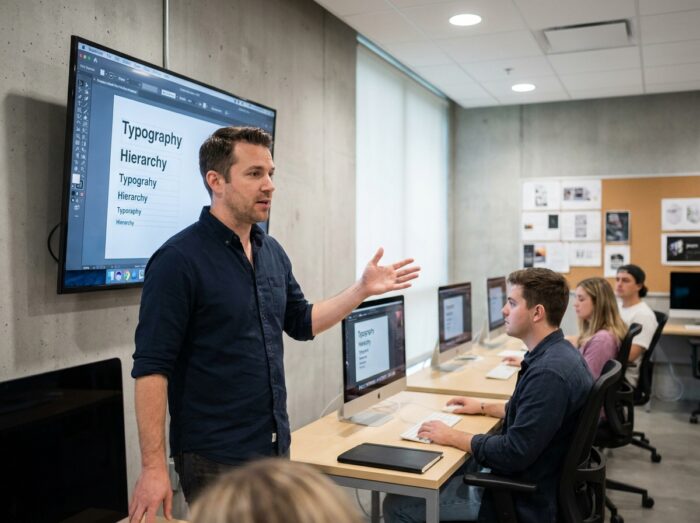
Graphic Design Training: Structured Curriculum or Self-Directed Learning
The choice between a graphic design school or online self-training depends less on initial talent than on the type of skills targeted. An academic program (BTS, DN MADE, professional license) structures progression over several semesters and imposes projects supervised by professionals. Self-training, on the other hand, offers total flexibility but requires considerable personal discipline.
Each path has its predictable shortcomings:
- Short training courses (a few days to a few weeks) allow for mastering a specific software but rarely cover the fundamentals of composition, color, or typography in depth.
- Long programs (two to five years) integrate visual culture, design history, and collaborative projects, but may take time to address recent tools or emerging practices like accessibility.
- Self-directed learning through online tutorials quickly develops software skills but often leaves a gap in project methodology and client relations.
The strongest path generally combines several of these routes. A stint in school lays the theoretical foundations, then ongoing self-training allows for keeping up with the evolution of tools and standards.
Mastery of Graphic Creation Software: Beyond the Adobe Suite
Photoshop, Illustrator, and InDesign remain industry standards. Most job offers in graphic design explicitly mention them. Knowing how to use them is a prerequisite, not a competitive advantage.
The difference lies in the depth of use. Many beginner graphic designers know the basic functions but struggle with tasks that require a finer technical understanding: color management for print, preparing files for offset printing, automation scripts in InDesign, or the accessible tagging of an exported PDF.
Alternatives like Figma (for web and UI design), Affinity Designer, or Canva occupy specific segments. Figma, in particular, has become a reference tool for real-time collaborative work on digital interfaces. A versatile graphic designer knows how to choose the right tool for the requested deliverable, not just the one they are most comfortable with out of habit.

The Trap of Tool Collection
Accumulating superficial software skills is a common pitfall in self-training. Mastering three software programs in depth is better than skimming over eight. Mastery is measured by the ability to solve an unexpected technical problem, not by the number of tutorials completed.
Generative AI and Graphic Creation: What It Changes in Training
The integration of artificial intelligence into graphic workflows alters the expected skills. Generating an image from a prompt is not, in itself, a graphic design skill. What matters is the ability to assess the quality of an AI-generated visual, to retouch it, to integrate it into an existing graphic charter, and to ensure it complies with usage rights.
A recent trend is to distinguish creations claiming human production from those incorporating AI as a tool. This distinction has concrete implications for graphic designers: knowing how to document one’s creative process becomes a professional skill. A client requesting a “handmade” visual expects traceability that the graphic designer must be able to provide.
Training programs are beginning to incorporate these issues, but unevenly. Academic programs often address AI from a theoretical or ethical perspective, while short courses focus on manipulating generative tools without always addressing legal or ethical issues.
Portfolio and Field Experience: The Final Filter
Regardless of the path taken, the portfolio remains the decisive document during recruitment or freelance mission searches. It is not just a simple catalog of achievements, but a demonstration of the ability to solve concrete visual problems.
An effective portfolio showcases the process as much as the result: preliminary research, iterations, justified color and typography choices, adaptation to brief constraints. Recruiters evaluate the approach, not just the final output.
Field experience, whether through internships, community projects, or initial freelance missions, complements theoretical training on a point that neither school nor tutorials truly cover: managing client feedback, balancing creative intent with technical constraints, and meeting production deadlines.
Mastery of graphic design is not limited to a diploma or a number of practice hours. It is the articulation between theoretical fundamentals, targeted software skills, and the ability to adapt to emerging standards (accessibility, AI, digital formats) that distinguishes an operational profile from one still under construction.