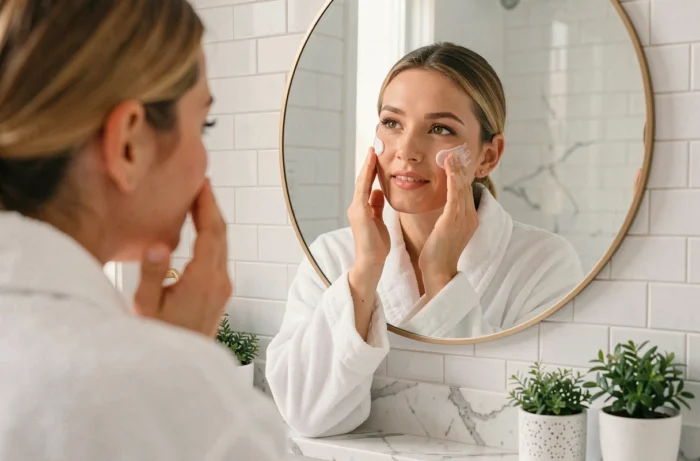
Enhancing your beauty on a daily basis is not just about piling products on your skin. Recent European regulations have changed the composition of many skincare and cosmetic products, which concretely alters the way to build an effective beauty routine. Comparing the gestures that truly matter, based on what the texts now impose on manufacturers, allows for more informed choices in front of the skincare or makeup aisle.
Cosmetic Regulation in Europe: What Changes for Your Beauty Routine
Most online beauty advice overlooks a crucial fact: the formulas of your favorite products have changed or will change due to several European regulations. These modifications directly affect facial care, makeup, and body products.
| Substance or Category | Applicable Regulation | Limit or Measure | Deadline |
|---|---|---|---|
| Retinol (face creams) | Regulation (EU) 2024/996 | 0.3% maximum retinol equivalent | Market release prohibited since November 2025, stock depletion until May 2027 |
| Retinol (body lotions) | Regulation (EU) 2024/996 | 0.05% maximum retinol equivalent | Same deadlines |
| Fragrance allergens | Regulation (EU) 2023/1545 | Expanded list from 26 to over 80 substances, declaration threshold of 0.001% for leave-on products | Gradually applicable |
| Microplastics | REACH restriction (EU) | Gradual ban on intentionally added microplastics | Phased according to product categories |
This table summarizes the three regulatory axes that are transforming the composition of skincare products. Concretely, a day cream purchased in 2024 and a day cream purchased in 2026 may contain very different dosages of retinol or fragrance substances.
To delve deeper into the gestures and products suited to these changes, the site mes-secrets-de-beaute.fr in detail offers additional resources on daily skincare and makeup.

Facial Care and Retinol: Adapting Your Routine to New Dosages
Retinol remains a reference active ingredient for smoothing skin texture and reducing the appearance of fine lines. However, the cap of 0.3% retinol equivalent in facial products requires rethinking how to incorporate it into a routine.
Retinol or Glycolic Acid Depending on Skin Type
For sensitive skin, low-concentration retinol may be enough to stimulate cell renewal. Combination to oily skin tolerates glycolic acid better, which acts on the surface to enhance skin radiance without causing the same peeling.
- Dry or mature skin: prioritize a retinol serum applied in the evening, followed by a rich moisturizing cream, while respecting the regulatory limit of 0.3%
- Combination or oily skin: alternate a glycolic acid exfoliant two evenings a week with a lightweight moisturizing treatment in the morning
- Reactive skin: start with a frequency of one evening out of three and gradually increase, regardless of the active ingredient chosen
Combining both actives on the same evening is not recommended. Their action pH differs, and layering them increases the risk of irritation without proven additional benefits.
Fragrance Allergens: Read the Labels of Your Makeup and Skincare Products
The expansion of the list of fragrance allergens to over 80 declarable substances has a direct consequence for those building a beauty routine: it becomes possible to precisely identify problematic molecules on the packaging.
Before this update, only 26 substances had to appear on the INCI list. This meant that a fragrance, cream, or foundation could contain allergens that were not identifiable by the consumer. This is no longer the case for products compliant with Regulation (EU) 2023/1545.
The Reflex to Adopt for Your Leave-On Products
The declaration threshold set at 0.001% specifically concerns products that remain on the skin: day cream, serum, foundation, lip balm. For these products, each fragrance substance present above this threshold must appear individually in the ingredient list.
Checking this list before purchasing a scented skincare or makeup product takes just a few seconds. Those prone to redness, itching, or contact eczema now have much more complete information to avoid risky products.

Microplastics in Cosmetics: Impact on Your Beauty Product Choices
The REACH restriction on intentionally added microplastics affects several categories of cosmetics. Bead exfoliants, certain long-wear foundations, and hair products contain (or contained) synthetic polymers in the form of microparticles.
Manufacturers are gradually reformulating their products to replace these microplastics with biodegradable alternatives. This applies to both facial scrubs and certain textures of lipstick or mascara that used plastic particles to enhance wear or texture.
For the consumer, the transition results in sometimes noticeable changes in texture. A reformulated scrub may offer a slightly different grain than its predecessor. Performance remains comparable, but the feel evolves.
Building a Reliable Daily Beauty Routine
Three gestures structure an effective routine, regardless of skin type or budget.
- Clean without stripping: a gentle cleanser morning and night is enough to remove sebum, pollution, and makeup residue without altering the skin barrier
- Hydrate with an appropriate treatment: a day cream compliant with the new composition standards ensures a regulated dosage of actives and transparent allergen labeling
- Protect from the sun: a daily sunscreen remains the most documented anti-aging gesture, well before any serum or targeted treatment
Makeup comes next, as an optional layer. A lightweight foundation, a bit of mascara, and a tinted lip balm are enough to structure a daily look without overloading the skin.
Hair follows the same logic of simplicity. A spaced shampoo (two to three times a week for most hair types) and a targeted conditioner for the lengths protect the fiber without weighing it down.
Daily beauty relies less on the number of products than on their relevance. With formulas now governed by precise retinol thresholds, increased transparency on allergens, and the gradual removal of microplastics, reading a product’s composition has become the most cost-effective beauty gesture.