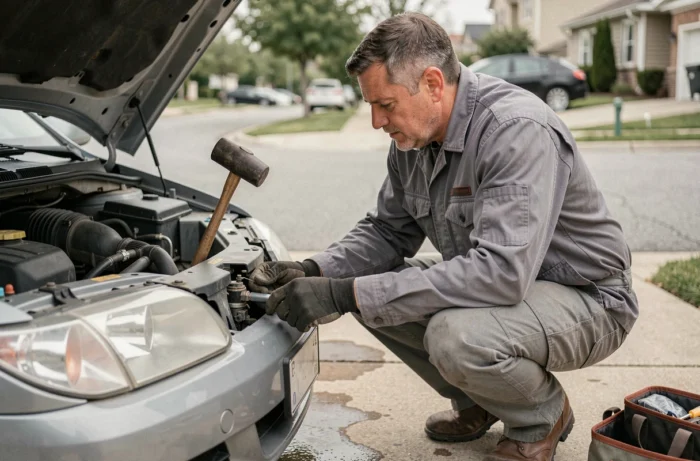
A starter that refuses to crank the engine often produces a sharp click followed by silence. The instinct to hit the starter exploits a simple mechanical principle: the shock can free worn or stuck brushes against the commutator, temporarily restoring electrical contact. This maneuver is not a repair, but a diagnostic test that helps distinguish a faulty starter from another electrical issue.
Why a mechanical shock unlocks the starter
The starter contains an electric motor whose brushes (small carbon pieces) constantly rub against a rotating commutator. Over time, these brushes wear out or get stuck in their housing. When they remain locked in a position where contact is no longer made, current does not flow, and the motor does not turn.
A light tap on the body of the starter is enough to vibrate the internal components and reposition the brushes against the commutator. The circuit closes, current flows again, and the motor can start. If the car starts again after this action, it confirms that the brushes or internal contacts are degraded.
This diagnosis guides the next steps: either replacing the brushes (less expensive) or completely changing the starter. In both cases, the problem will return, sometimes a few days later, sometimes at the next start. The technique of tapping on a starter to start remains an emergency fix, not a lasting solution.
Where to hit the starter and with what tool
The striking area is the cylindrical body of the starter, which is the largest and metallic part. The solenoid (the small cylinder attached above or to the side) should not be struck: its internal contacts are fragile, and an impact can worsen the failure.
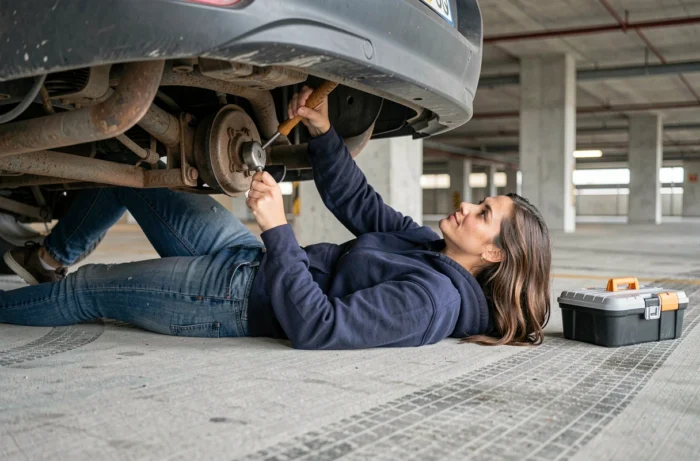
Hitting the electrical terminals or cables is to be avoided. A shock on a connection can cause an electric arc, damage the insulation, or loosen a connection that is already weakened.
For the tool, a long screwdriver handle or a small metal bar is suitable. The goal is to transmit a clear vibration without excessive force. A few moderate taps are sufficient.
- Locate the starter under the vehicle or from the engine compartment (depending on the model, it is located at the bottom of the engine block, on the transmission side).
- Tap two or three times on the cylindrical body with a rigid tool, avoiding the cables and the solenoid.
- Ask a second person to turn the ignition key while you tap, to immediately test the effect of the shock.
- Stop any attempt if you detect a burnt smell, smoke, sparks, or an abnormally hot cable.
Battery, cables, and ground: the false diagnostics of the starter
Before concluding that a starter is faulty, several elements of the starting circuit deserve a check. A weak battery produces an identical symptom: a single click without the engine starting. In this case, tapping on the starter will change nothing since the problem is upstream.
Corroded battery terminals create resistance that prevents current from reaching the starter with enough power. A simple cleaning of the terminals (fine sandpaper or a wire brush) can solve the problem. Also check the engine-chassis ground cable: if it is loose or oxidized, the return current does not flow properly.
A voltage drop test on the starting circuit allows for a clear conclusion. This test measures the voltage loss between the battery and the starter during a starting attempt. If the drop exceeds the normal value, the fault lies in the wiring and not in the starter itself.
Limits and risks of repeated attempts
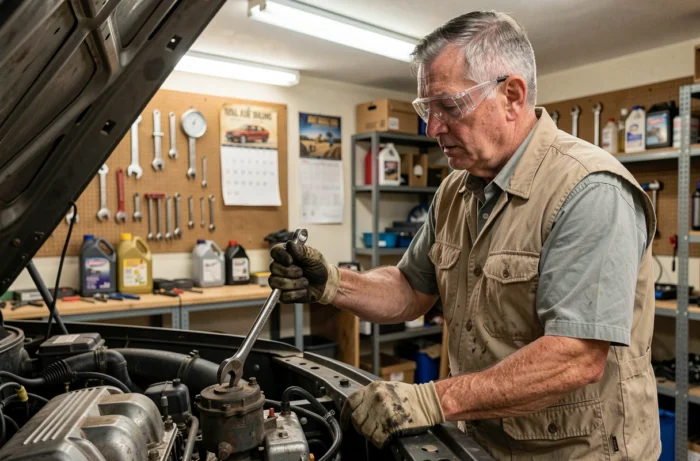
The position of the starter presents the first practical difficulty. On many recent vehicles, it is embedded under engine components or accessible only from underneath, sometimes behind the still-hot exhaust manifold. Working under a vehicle without proper jack stands poses a serious risk.
Multiplying starting attempts has direct consequences on the battery. Each attempt consumes a significant amount of energy. After several unsuccessful tries, the battery may become too discharged to power even a functional starter.
Heating is another factor to watch. The starter is designed to operate for a few seconds at a time, not under prolonged stress. Close attempts raise the temperature of the electric motor, cables, and connections. In extreme cases, the insulation of the wires can melt.
- Limit attempts to three or four maximum before allowing the system to rest for several minutes.
- Never combine a jump start (to improve) with hits on the starter: the extra current amplifies the risks of electric arc.
- If the starter does not respond after a few taps, the problem likely exceeds brush wear, and the maneuver will resolve nothing.
The act of tapping on a starter remains a useful troubleshooting reflex to confirm internal wear and to temporarily get going. Once the engine is restarted, the priority is to drive directly to a workshop or to plan for the replacement of the part, as the fault will reappear without warning, often under the least favorable conditions.