
Furnishing a home without being able to drill, repaint or alter the finishes is part of everyday life for most renters. The issue has taken on added significance since January 1, 2025: in mainland France, homes rated G on the DPE energy performance scale can no longer be offered under a new lease, with ratings F and then E to follow in 2028 and 2034.
Decorating a rental means working with walls you didn’t choose, insulation you can’t control and a landlord who decides which improvements get made.
Indoor air quality and new furniture: what the label doesn’t cover
Paints and wall and floor coverings sold in France carry a VOC emissions label rated from A+ to C. This regulatory requirement offers reassurance, but it doesn’t apply to furniture. New furniture made from particleboard releases formaldehyde for several weeks after delivery.
In practical terms, adding a new sofa, a flat-pack bookcase and a particleboard coffee table to a poorly ventilated room can worsen air quality far more than applying a coat of A+ rated paint. The solution is simple: air out each new piece of furniture in an open room for several days before bringing it inside, and check that the home’s mechanical ventilation system is working properly.
This is directly connected to energy efficiency. In homes rated E or F, ventilation is often inadequate or deliberately reduced by occupants to limit heat loss. Adding new furniture in these conditions makes the problem worse. We recommend reporting any ventilation system issues to the landlord before investing in furniture, since good airflow is essential for both thermal comfort and a healthy indoor environment.
Specialist resources can help you explore furnishing, materials and renovation together, such as https://www.maisonea.fr, which covers these topics from a range of perspectives.
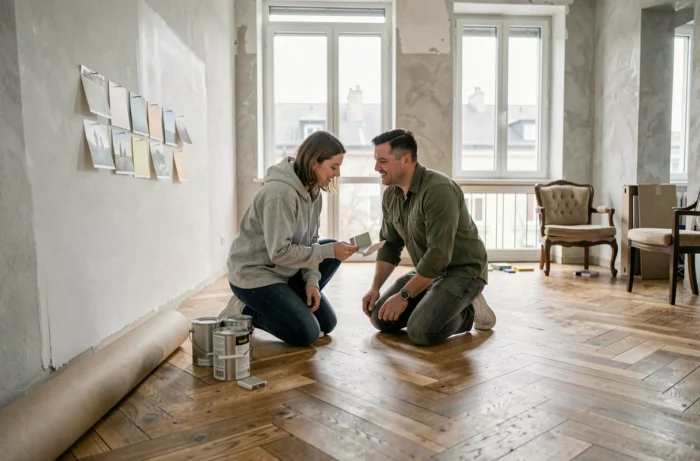
Decorating a rental: add your own style without renovations or DPE issues
Tenants who carry out interior insulation work without the landlord’s consent risk a dispute. Worse, changes made without coordinating with the home’s energy performance assessment could complicate its next evaluation. The rules are clear, and they shape your decorating choices.
Removable wall and floor coverings
In a rental, only solutions that don’t alter the existing surface are practical. Repositionable peel-and-stick wallpaper, floating click-lock PVC tiles and magnetic or adhesive wall panels can completely transform a room without altering the structure.
- Click-lock tiles can be laid directly over existing tile or vinyl flooring, with no adhesive or floor leveling, and removed when you move out.
- Repositionable wallpaper sticks to smooth surfaces and peels off without leaving residue, provided you avoid damp walls and limewash paint.
- Wood slats attached with adhesive brackets create a screen or headboard effect without drilling, with a finish comparable to screw-mounted slats.
These changes affect neither the home’s thermal envelope nor its utility systems, so they have no impact on its DPE rating.
Lighting and atmosphere without electrical work
Lighting transforms a room more than wall color does. Adding several low-level light sources—table lamps, string lights and cordless wall lights—creates distinct zones within the same space. Rechargeable battery-powered wall lights, introduced in recent years, offer a look similar to wired sconces without the need to run any cables.
Choosing warm color temperatures (around 2700 K) for living areas and more neutral ones for workspaces is enough to define the interior without changing the electrical installation.
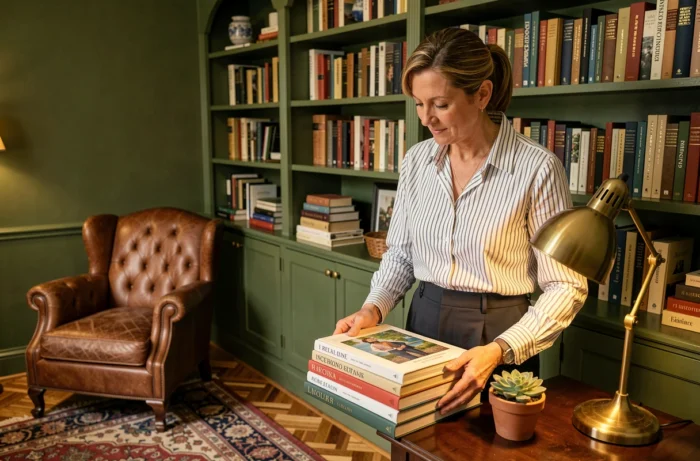
Reusing furniture: a practical choice as well as an aesthetic one
Well-inspected secondhand furniture no longer emits VOCs, unlike its new particleboard equivalent. Volatile compounds dissipate gradually after manufacturing, making secondhand furniture a healthier choice for indoor air quality.
Beyond its environmental benefits, reuse solves a practical decorating challenge: finding distinctive pieces at an affordable price. A 1960s solid-wood sideboard, sanded and waxed, often costs less than a comparable new piece and has a patina that can’t be replicated industrially.
What to check before buying
- Check the structural stability: if the joints are loose, the piece will need to be reglued with PVA glue and clamped in a press—something you can do without a workshop.
- Check the inside surfaces of drawers and the back of the furniture for mold, which can indicate storage in a damp environment.
- Avoid furniture painted before the 1980s unless it has been tested first: lead-based paints were common, and sanding releases toxic particles.
Reusing furniture doesn’t mean you can skip a coherent furnishing plan. Collecting mismatched pieces without a unifying theme can make a home feel cluttered. Choose a palette of two or three dominant materials—light wood and black metal, or oak and linen, for example—before you start hunting for pieces to ensure a cohesive look.
Arranging your space: proportion mistakes that throw off a room
The main cause of discomfort in a well-furnished home isn’t color or style, but the relationship between furniture size and room volume. A 280 cm corner sofa in a 15 m² living room feels overwhelming, even with carefully chosen decor.
As a rule of thumb, leave at least 60 cm of clear space around each piece of furniture. In small rooms, wall-mounted furniture—shelves and floating consoles—keeps the floor clear and makes the space feel larger without sacrificing storage.
A piece of furniture that’s too low in a high-ceilinged room exaggerates the vertical imbalance. Conversely, a tall wardrobe in a room with a low ceiling makes the space feel cramped. Matching furniture height to ceiling proportions is more effective than any color choice when it comes to bringing a room into balance.
Another common mistake is placing all the furniture against the walls. Pulling a sofa 15 cm away from the wall, angling an armchair into a dead corner or placing a table perpendicular to the window instead of parallel to it can bring a static layout to life. You don’t create more space by emptying the room, but by organizing how people move through it.