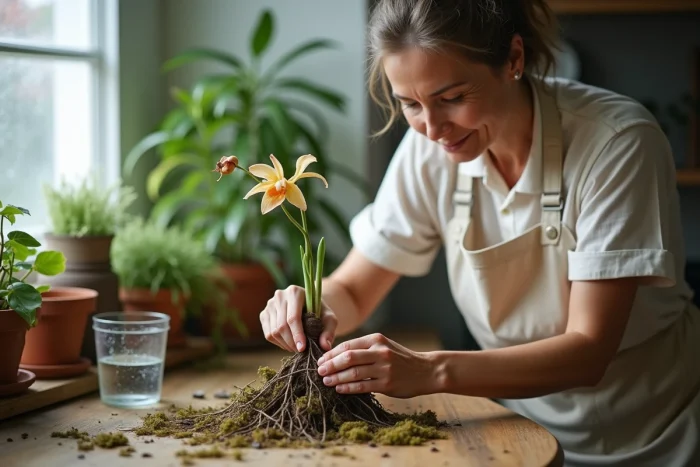
An orchid with wilted leaves and gray roots is not necessarily doomed. The distinction between a dormant plant and a truly dying plant hinges on one precise point: the state of the apical meristem, the heart of the rosette from which new leaves emerge. As long as this area remains firm and green, recovery is still possible. If the meristem is completely rotten or torn out, specialists consider the orchid to be irrecoverable, regardless of the trick used.
Apical meristem of the orchid: the diagnosis that no one makes before acting
Before soaking, cutting, or repotting, the first reflex should be to examine the top of the rosette. Soft, brown roots attract all the attention, but they are just a symptom. The real verdict is determined higher up.
Gently pull apart the central leaves. If the heart is black, spongy, or emits a smell of decay, the plant has lost its ability to produce new leaves. In this case, the only realistic option is to monitor for the possible appearance of keikis (those small seedlings that sometimes arise on flower stalks) or to accept the loss.
On the other hand, a still pale and compact meristem, even surrounded by yellowed leaves, indicates that there is still vitality left. It is from this observation that the rescue work makes sense. It is possible to revive a dead orchid with a pinch of method, provided that this growth point is intact.
Root pruning and fungicide treatment: the effective rescue protocol
Once the diagnosis is made, root pruning is the first concrete intervention. Remove the plant from the pot, take off all the old substrate, and inspect each root. Healthy roots are firm, green or white with green tips. Anything that is brown, soft, or hollow should go.
Use disinfected pruning shears with alcohol. Cut cleanly above the damaged part. On the exposed sections, powdered cinnamon remains a commonly cited antifungal from the pantry, but recent technical guides highlight biological fungicides based on Trichoderma or Bacillus subtilis to limit rot and improve recovery rates.
These biological products colonize the cut surfaces and prevent pathogenic fungi from settling. They can be found at garden centers in powder or solution form to dilute. Apply them directly to the wounds before repotting.
Repotting after pruning
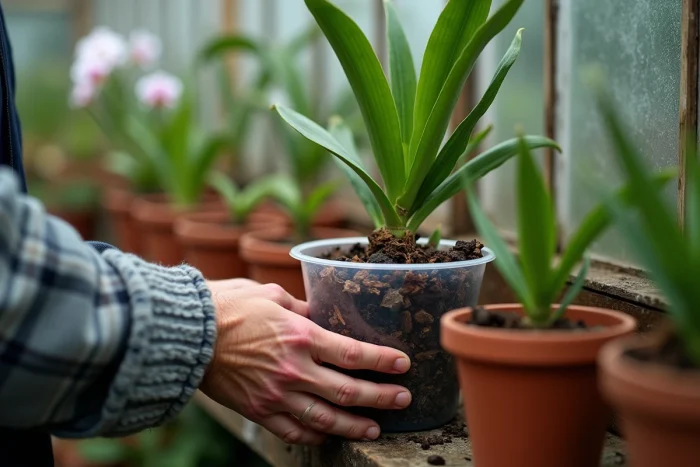
The choice of pot and substrate determines the next steps. A transparent pot allows you to monitor the condition of the roots without disturbing the plant. The substrate must be new: medium-grade pine bark, possibly mixed with sphagnum to maintain a minimum of moisture around the weakened roots.
- Pine bark alone for orchids that still retain several healthy roots, as rapid drainage limits the risk of rot
- Mix of bark and sphagnum for very weakened plants with few roots, to maintain light moisture without excess stagnant water
- Transparent pot is mandatory to visually follow root recovery and adjust watering accordingly
Reduced light and minimal watering: the convalescence of the Phalaenopsis orchid
The common reflex after an emergency repotting is to water generously and place the plant near a well-exposed window. Feedback from professional growers indicates the opposite: significantly reducing light and watering for a few weeks after pruning yields better results.
An orchid amputated of the majority of its roots cannot absorb water normally. Exposing it to bright light stimulates evaporation through the leaves without the roots being able to compensate, which accelerates dehydration. Place it in a bright spot but out of direct sunlight, at a stable temperature around twenty degrees.
Watering during the recovery phase
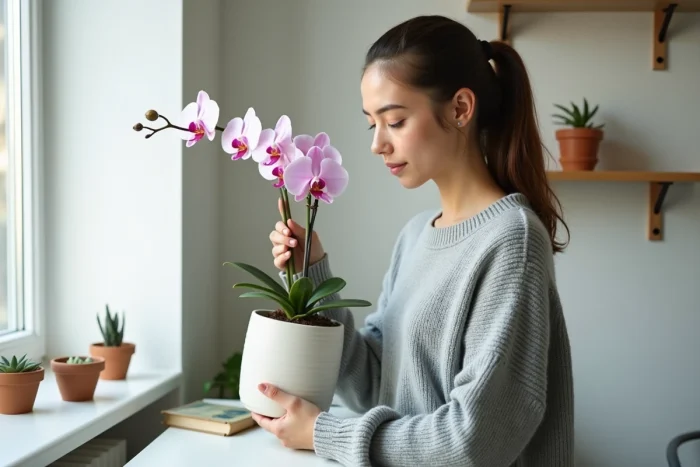
Lightly mist the surface of the substrate rather than soaking the pot. The goal is to maintain a constant humidity but never waterlogged. Full soaking only becomes relevant once new green root tips appear, a sign that the plant is starting to actively absorb again.
This convalescence phase lasts several weeks. The available data does not allow for a precise timeline, as recovery depends on the initial state of the plant, ambient temperature, and the number of remaining roots.
Garden center orchids: why some never recover
A factor rarely addressed in consumer guides concerns the origin of the plant. Many Phalaenopsis orchids sold in supermarkets arrive already very weakened by intensive cultivation under fertilizers and flowering hormones. These plants have been pushed to produce spectacular flowers for sale, at the expense of their root system and energy reserves.
When such an orchid loses its flowers and then its leaves within a few weeks, the problem does not necessarily stem from a maintenance error. The plant was already in deficit at the time of purchase. Field reports vary: some enthusiasts achieve the same results with patience, while others find that the plant declines despite all care.
- Check the roots upon purchase by looking through the transparent pot: predominantly gray or brown roots indicate a pre-existing problem
- Prefer orchids with rigid, dark green leaves, a sign of sufficient energy reserves
- Repot in fresh substrate as soon as you return home if the original substrate is compacted or decomposed
Rescuing an orchid relies less on a miracle ingredient than on a sequence of precise actions. Diagnosis of the meristem, clean pruning of the roots, appropriate fungicide treatment, repotting in draining substrate: each step matters. When the heart of the plant is still viable, patience in filtered light during recovery offers a real chance of revival.
When it is no longer viable, it is better to focus your energy on the next purchase, this time choosing a plant with healthy roots from the start.